Blog Details
NPT vs BSPP vs SAE ORB vs Metric Threads for Hydraulic Quick Couplings: Identification, Sealing and Selection
A hydraulic quick coupling can have the correct mating profile and still be the wrong part for the machine. One of the most common causes is the rear connection thread.
Two 1/2-inch ISO 16028 flat-face couplings may connect to the same mating nipple, yet one may have a G1/2 BSPP port, another a 1/2 NPT port, and another an M22×1.5 metric connection. Their quick-coupling interfaces may be interchangeable. Their rear connections are not.
This guide compares the rear-port thread systems most often specified on hydraulic quick couplings: NPT, BSPP, SAE straight-thread O-ring boss (ORB), and metric. It explains how to identify each connection, where it seals, and what information is required before ordering a replacement.
1. Quick-Coupling Size and Rear Thread Size Are Different Specifications
A hydraulic quick coupling has two independent interfaces.
Quick-coupling interface
The front interface determines whether the male nipple and female coupler can mate. Common examples include ISO 7241 Series A, ISO 7241 Series B, ISO 16028 flat face, ISO 5675 agricultural, and manufacturer-specific profiles.
Rear port or termination
The rear connection determines how the coupling body connects to a hose, adapter, valve, manifold, rigid tube, or equipment port. Common terminations include NPT, BSPP, BSPT, SAE ORB, JIC 37°, ORFS, and metric designs.
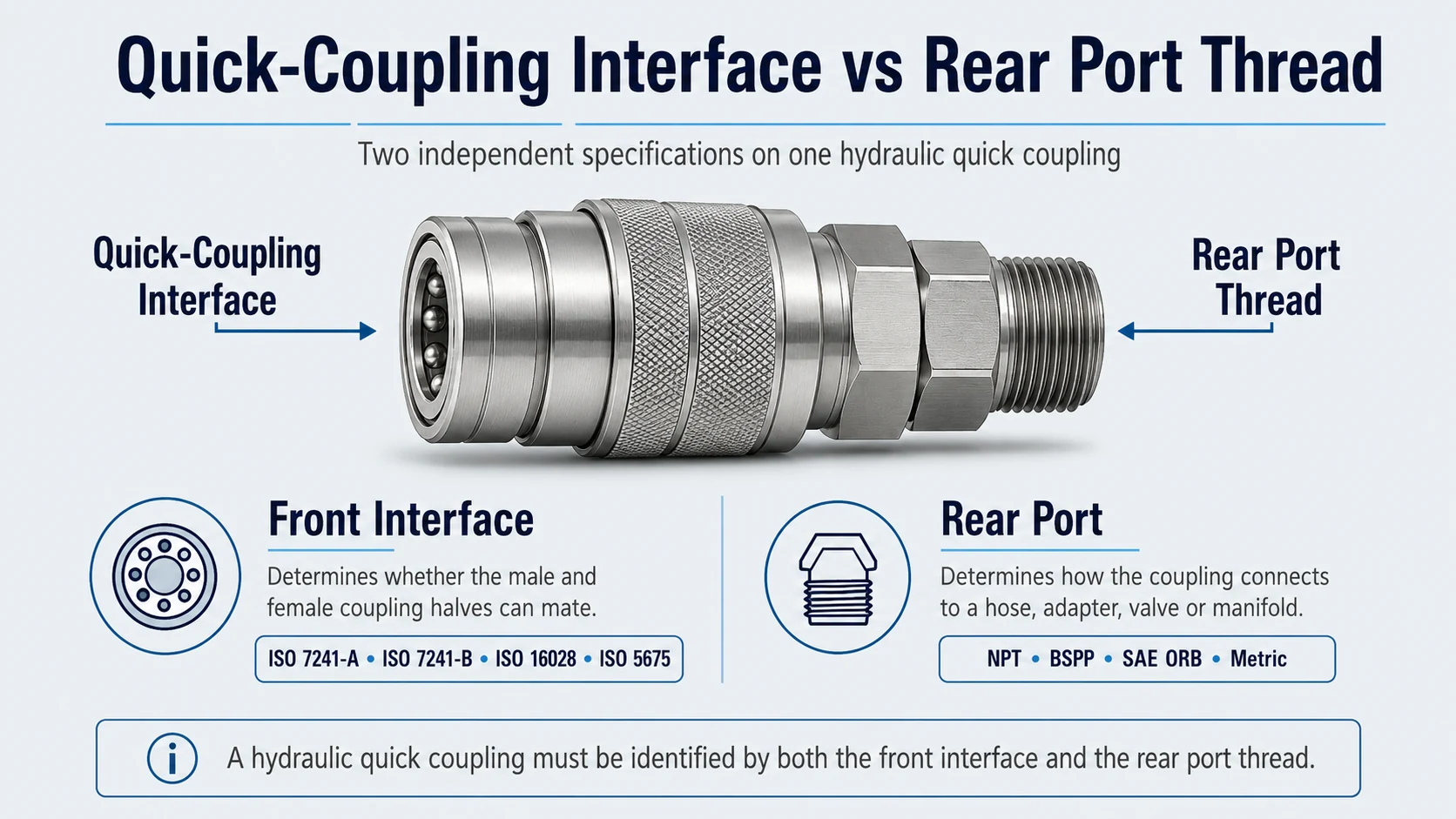
A complete description should identify both interfaces. For example:
- ISO 16028, 1/2-inch body size, G1/2 female BSPP
- ISO 7241-A, 1/2-inch body size, M22×1.5 male
The first part identifies the quick-coupling profile and nominal body size. The second identifies the rear connection. A marking such as “1/2” alone is therefore not enough to select a replacement.
2. NPT vs BSPP vs SAE ORB vs Metric: Quick Comparison
| Feature | NPT | BSPP | SAE ORB | Metric |
|---|---|---|---|---|
| Typical designation | 1/2 NPT | G1/2 | -8 ORB / 3/4-16 UNF | M22×1.5 |
| Thread form | Tapered | Parallel | Parallel | Usually parallel |
| Thread angle | 60° | 55° Whitworth | 60° Unified | 60° ISO metric |
| Primary standard | ASME B1.20.1 | ISO 228-1 | SAE J1926 | ISO 261 / ISO 68-1 |
| Primary seal | Thread engagement with the specified sealant practice | Separate seal outside the thread | O-ring at the port | Depends on connection design |
| Typical market | North America | Europe and international equipment | North American mobile and industrial hydraulics | European, Asian, and global OEM machinery |
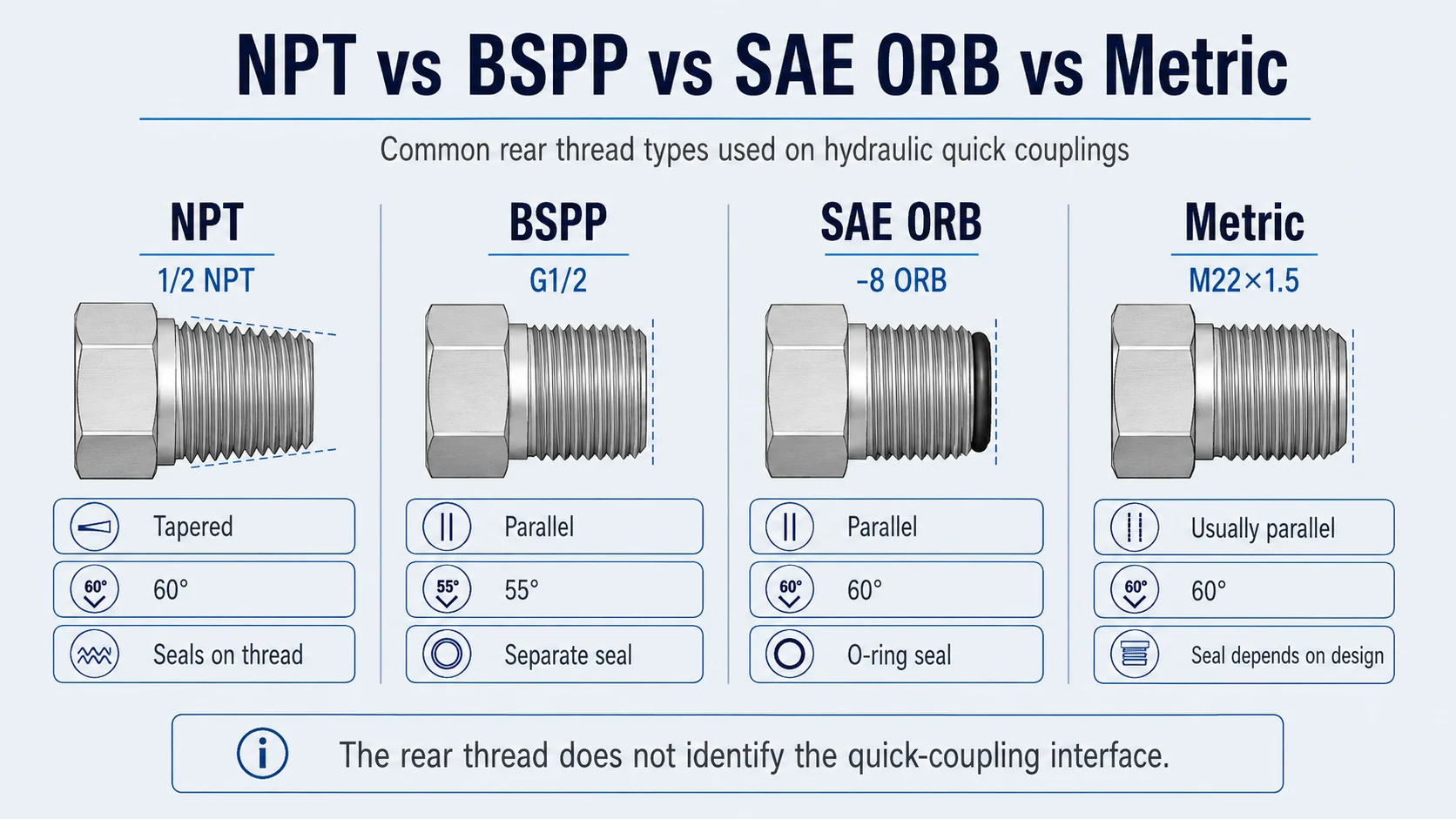
These designations describe the rear port only. They do not identify the coupling’s front mating profile or confirm its pressure rating.
3. NPT Threads on Hydraulic Quick Couplings
NPT means National Pipe Taper. It is widely used on hydraulic quick couplings supplied to North American equipment manufacturers, hose shops, and distributors. Typical designations include 1/4 NPT, 3/8 NPT, 1/2 NPT, 3/4 NPT, and 1 NPT.
The defining feature is the taper. The male thread diameter increases toward the hexagon; the female thread becomes smaller deeper in the port. As the parts are assembled, flank interference increases. ASME B1.20.1 provides the dimensional and gauging basis for general-purpose NPT threads.
Where NPT seals
The threaded joint is part of the pressure seal. Hydraulic installations commonly require a compatible liquid or paste sealant, or another installation method approved by the equipment manufacturer. The sealant must be suitable for the hydraulic fluid, temperature, pressure, and contamination requirements.
Do not treat extra tightening as a universal leak repair. Excessive torque can split a female port, distort a coupling body, or make future removal difficult. NPT assembly should follow the component supplier’s engagement and torque instructions.
Typical specification
ISO 7241-A, 1/2-inch body, 1/2 NPT female
The two “1/2” references describe different nominal systems. Neither should be interpreted as the measured outside diameter of the thread.
4. BSPP Threads on Hydraulic Quick Couplings
BSPP means British Standard Pipe Parallel. It is normally identified by the letter G, for example G1/4, G3/8, G1/2, G3/4, and G1.
BSPP has a parallel Whitworth-form thread with a 55° thread angle. The major diameter remains essentially constant along the threaded portion.
BSPP does not seal through the thread
ISO 228-1 defines parallel pipe threads for joints where pressure-tightness is not created by the threads themselves. The thread holds the connection together; a defined sealing surface and sealing element retain the fluid.
Depending on the port design, the seal may be an O-ring, bonded seal, elastomeric washer, metal washer, or a specified cone or face. If a BSPP connection leaks, inspect the sealing element, mating face, port geometry, and thread damage before applying more torque.
5. SAE ORB Threads on Hydraulic Quick Couplings
The description “SAE thread” is not precise enough for a purchase order. Several hydraulic connections use Unified inch threads. SAE O-Ring Boss, usually abbreviated ORB, is one of the most common rear-port choices on North American mobile equipment and manifolds.
An ORB connection uses a straight UN/UNF thread, a dedicated O-ring, and a machined port sealing area. SAE J1926 defines this connection family. Typical dash sizes include -4, -6, -8, -10, -12, and -16 ORB. For example, -8 ORB commonly uses a 3/4-16 UNF thread.
Where SAE ORB seals
The O-ring provides the fluid seal; the straight thread provides mechanical retention. Pipe-thread tape or sealant is not the primary sealing mechanism. When an ORB joint leaks, check O-ring material and condition, the port chamfer, sealing land, lubrication, and installation damage.
ORB must not be confused with JIC 37°. Both may use Unified straight threads, but ORB seals with an O-ring at the port while JIC seals at a 37° metal cone/flare interface.
6. Metric Threads on Hydraulic Quick Couplings
Metric threads are common on European and Asian machinery and on global OEM equipment. Typical rear-thread callouts include M18×1.5, M20×1.5, M22×1.5, M24×1.5, M26×1.5, M27×2, and M30×1.5.
In M22×1.5, “M” identifies the ISO metric thread system, “22” is the nominal major diameter in millimetres, and “1.5” is the pitch in millimetres. ISO 261 provides the general plan for ISO metric threads, while ISO 68-1 defines the basic profile.
M22×1.5 does not define the seal
A metric thread designation identifies thread geometry, not the complete hydraulic connection. An M22×1.5 termination might use an O-ring port, bonded seal, sealing washer, 24° cone, or another defined arrangement. The mating port and sealing method must be identified separately.
7. M22×1.5 and G1/2 BSPP Are Not Interchangeable
M22×1.5 and G1/2 BSPP are often confused because their outside diameters are close. Their standards are different:
| Feature | M22×1.5 metric | G1/2 BSPP |
|---|---|---|
| Nominal basis | 22 mm major diameter | 1/2 nominal pipe size |
| Pitch | 1.5 mm | 14 TPI, approximately 1.814 mm |
| Thread angle | 60° | 55° |
| Thread system | ISO metric | ISO 228-1 parallel pipe |
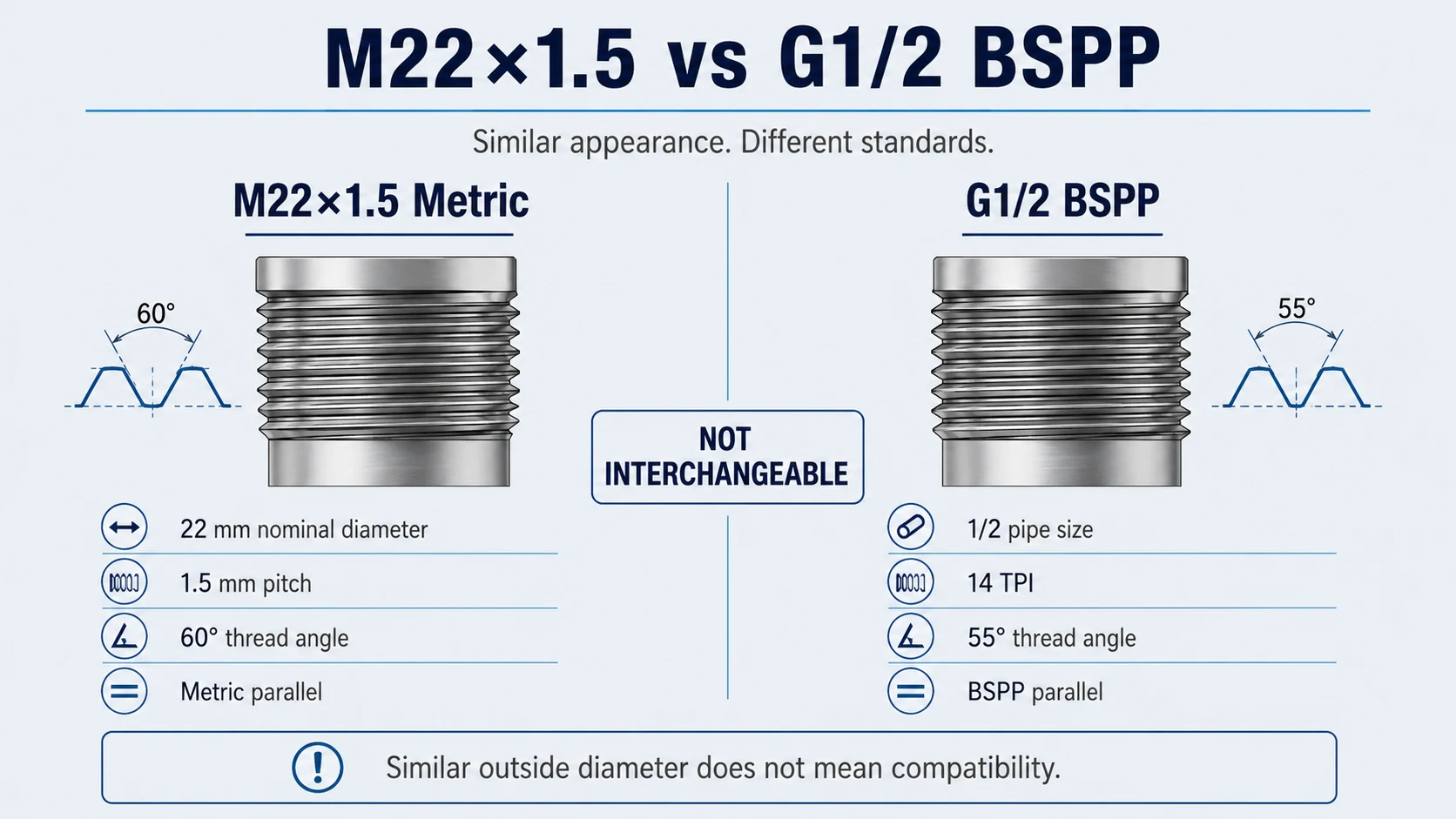
A mismatched part may start for one or two turns, but the different pitch and thread form prevent correct engagement. Stop if assembly does not turn freely by hand. Forcing the joint can damage both components without producing a safe pressure connection.
8. How the Four Connection Types Seal
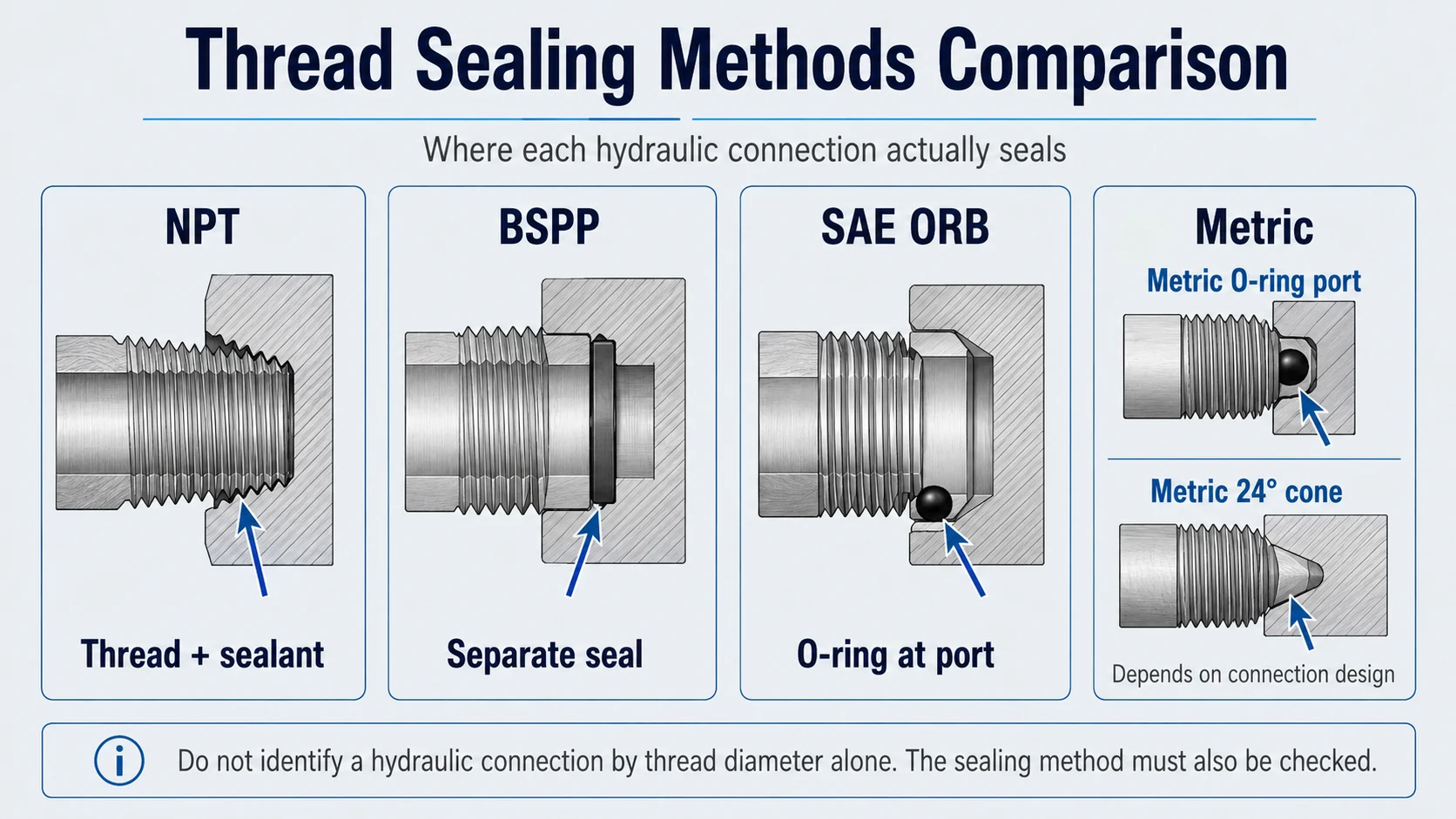
| Connection | What the thread does | Where the pressure seal occurs | Primary inspection point |
|---|---|---|---|
| NPT | Provides retention and tapered interference | Within the threaded joint using the specified sealant practice | Thread form, damage, engagement, sealant compatibility |
| BSPP | Provides retention | At a separate washer, O-ring, cone, or face | Sealing element and mating face |
| SAE ORB | Provides retention | At the O-ring and port chamfer | O-ring, chamfer, and sealing land |
| Metric | Depends on the defined connection | O-ring, washer, 24° cone, or another specified surface | Complete port standard, not the M designation alone |
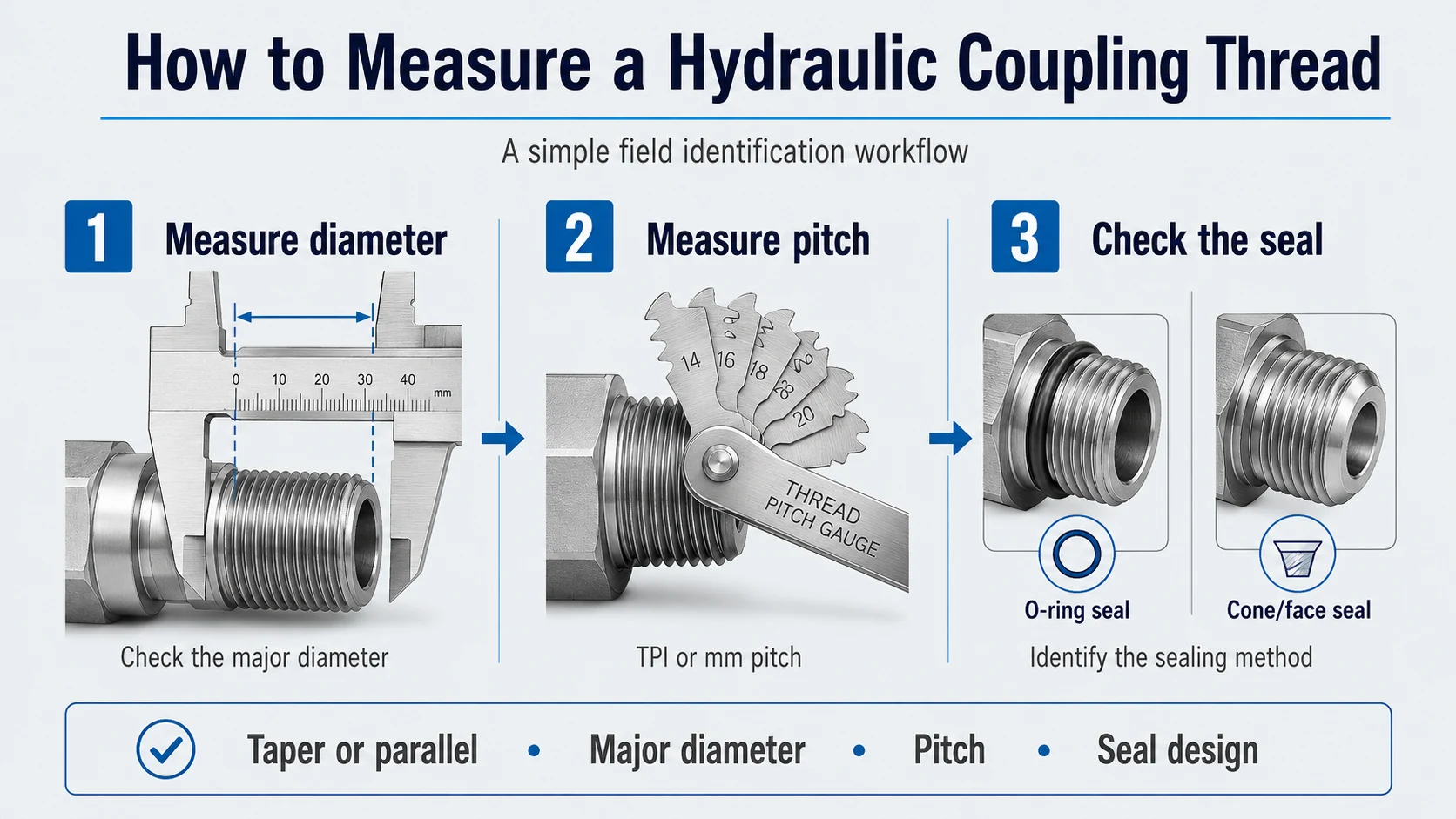
9. How to Identify an Unknown Hydraulic Coupling Thread
Use a process of elimination. A single diameter measurement is not enough.
Step 1 — Separate the front interface from the rear port
Record the quick-coupling profile and body size independently. A G1/2 rear port does not tell you whether the front interface is ISO 7241-A, ISO 7241-B, ISO 16028, ISO 5675, or a proprietary profile.
Step 2 — Determine tapered or parallel
Measure a male thread near the end and again near the hexagon. A meaningful diameter increase suggests a tapered thread. Nearly equal readings suggest a parallel thread. Use the correct plug or ring gauge for final confirmation.
Step 3 — Measure the major diameter
Use a calibrated vernier or digital caliper. Measure male threads across the crests and female threads using the appropriate internal measurement method. Compare the value with a current thread chart; nominal pipe size is not the measured diameter.
Step 4 — Measure pitch
Use a thread-pitch gauge. Inch systems are commonly identified by threads per inch (TPI), while metric systems use millimetres between adjacent crests. Do not estimate pitch from a photograph.
Step 5 — Inspect the thread profile and sealing feature
Check whether the thread form is 55° or 60°, and locate the actual seal: tapered thread, O-ring, bonded washer, face, or cone. The seal design often eliminates otherwise similar candidates.
Step 6 — Verify markings and drawings
Record the manufacturer, series, part number, and any stamped port code. Confirm the result against the current manufacturer drawing or applicable standard before pressure testing.
10. Identification Checklist
| Check | What to record | Error prevented |
|---|---|---|
| Front coupling profile | Standard or manufacturer series, body size, male/female half | Matching the port while selecting the wrong mating interface |
| Taper | Tapered or parallel, preferably gauge-confirmed | Confusing NPT with a parallel connection |
| Diameter | Measured major diameter and measurement location | Ordering by nominal size alone |
| Pitch | TPI or millimetres | Confusing M22×1.5 with G1/2 |
| Thread form | 55° Whitworth or 60° Unified/metric, where applicable | Forcing visually similar threads together |
| Seal | O-ring, bonded seal, face, cone, or thread seal | Using sealant where a separate seal is required |
| Markings | Brand, series, part number, port code, pressure marking | Losing the strongest cross-reference evidence |
11. Compatibility Rules for Replacement Couplings
Matching the rear thread is necessary, but it does not establish complete interchangeability. A replacement must also match:
- quick-coupling profile and nominal body size;
- male or female coupling half;
- rear port thread and sealing arrangement;
- working pressure and pressure impulse requirements;
- required flow and acceptable pressure drop;
- fluid compatibility and seal compound;
- operating temperature and environment;
- connection-under-pressure requirements;
- material, coating, and corrosion resistance.
Use the Hydraulic Quick Coupling Interchange Guide for the complete replacement workflow, and the Quick Release Coupling Types guide to distinguish the main front-interface families.
12. Common Ordering and Installation Mistakes
Assuming every 1/2-inch description means the same size
Coupling body size, pipe-thread designation, dash size, and measured diameter are separate values.
Treating G1/2, 1/2 NPT, and M22×1.5 as substitutes
They have different geometry and sealing requirements. Similar outside diameter is not evidence of interchangeability.
Specifying only “SAE”
State whether the connection is SAE ORB, JIC 37°, or another design. “SAE thread” does not identify the sealing interface.
Identifying the quick coupling from the rear thread
Two couplings can share the same G1/2 port and have completely different front mating profiles.
Using sealant where an O-ring should seal
Sealant cannot replace a missing, cut, extruded, or chemically incompatible O-ring.
Assuming thread compatibility confirms pressure rating
Thread fit is only one part of the assembly. Confirm the pressure rating of every component and the derating required by the application.
13. What to Send with a Hydraulic Quick Coupling Enquiry
| Information | Example |
|---|---|
| Coupling interface | ISO 16028 flat face |
| Body size | 1/2 inch |
| Rear port | G1/2 female BSPP with bonded seal |
| Working pressure | 350 bar |
| Required flow | 70 L/min |
| Fluid | Mineral hydraulic oil |
| Seal material | NBR |
| Application | Excavator attachment |
| Existing identification | Brand, series, and part number if available |
If the thread is unknown, provide straight-on and side photographs of the complete coupling, close-ups of the port and seal, measured diameter, pitch, and all visible markings. A photograph alone is rarely sufficient for final identification.
For a measurement-led workflow, use the hydraulic coupling thread identification guide. If the connection is already identified but still leaks, continue with the hydraulic thread sealing and leak diagnosis guide.
14. Frequently Asked Questions
Is NPT the same as BSPP?
No. NPT is a tapered 60° pipe-thread system whose threaded joint participates in sealing. BSPP is a parallel 55° pipe thread that requires a separate sealing arrangement.
Is G1/2 the same as 1/2 NPT?
No. G1/2 identifies a BSPP parallel thread. 1/2 NPT identifies an NPT tapered thread. They are not substitutes.
Does BSPP need thread tape?
The BSPP thread is not intended to create the pressure seal. Use the sealing element specified for the connection—such as an O-ring or bonded washer—and follow the component manufacturer’s instructions.
Does SAE ORB require thread sealant?
Normally no. The O-ring is the designed pressure seal. Confirm O-ring condition, compound, port geometry, lubrication, and installation requirements.
What does -8 ORB mean?
It is an SAE straight-thread O-ring boss size. In common hydraulic use, -8 ORB uses a 3/4-16 UNF thread. The O-ring, not the thread, provides the fluid seal.
Can two quick couplings have the same rear thread but fail to connect?
Yes. The rear port and front quick-coupling interface are independent. Two G1/2 couplings may belong to different ISO or proprietary mating profiles.
Can an NPT fitting screw into a BSP connection?
Incorrect threads may begin to engage when dimensions are close, but partial engagement does not establish compatibility. Do not force or pressure-test the joint until the exact standards are verified.
15. Selection Summary
Identify a hydraulic quick coupling in this order:
- Identify the front quick-coupling profile and body size.
- Determine whether the rear thread is tapered or parallel.
- Measure major diameter and pitch.
- Confirm thread form and the actual sealing location.
- Verify markings against a current drawing or standard.
- Check pressure, flow, fluid, seal, temperature, and application requirements.
NPT, BSPP, SAE ORB, and metric threads cannot be selected by appearance or nominal size alone. The safest specification records the mating interface, rear port, seal design, and operating requirements as separate fields.
Reference standards: ASME B1.20.1 for NPT; ISO 228-1 for BSPP pipe threads; SAE J1926 for straight-thread O-ring boss ports and stud ends; ISO 68-1, ISO 261, and ISO 724 for ISO metric screw threads. Always use the current edition and the component manufacturer’s dimensional drawing for final verification.
Latest Blog